The lab is an essential stage in the film development process. It is here that the captured light—the still latent image—truly becomes a photograph.
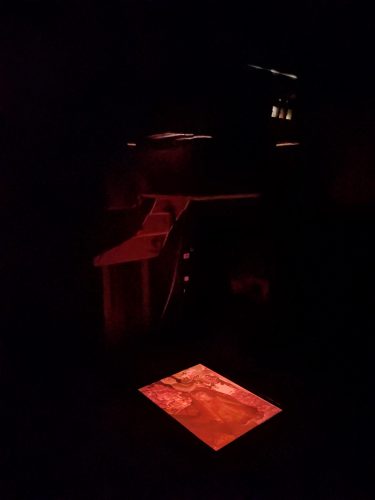
Each film undergoes a choreography of precise gestures: the tanks turned by hand, the retouching under the enlarger, the prints slowly revealing themselves in the trays. All in silence and the smell of chemicals.
It is sensory work, where you listen to time as much as you control it.
This materiality is unique to film photography: a photograph that is born in darkness, is revealed with water and slowly dries in the air.
Artisanal color and black&white film processing
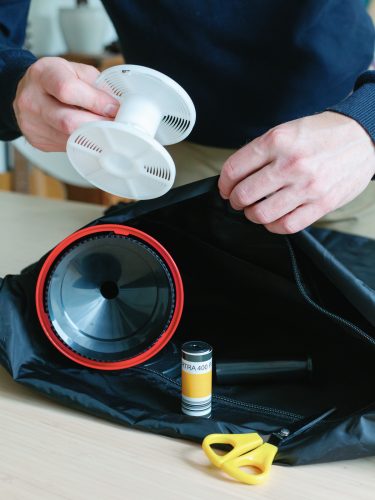
The development of 35 mm or medium format film, color or black and white, is done entirely by hand, using a single-use bath.
The choice of developer is adapted to each project, depending on the desired result.
The negatives are washed manually, by renewing the water, to ensure their best preservation.
Water use and chemical bath management are carried out in an eco-responsible manner.
Digitisation is not at the core of my practice, which remains primarily focused on paper, enlarging, and the materiality of the photographic object.
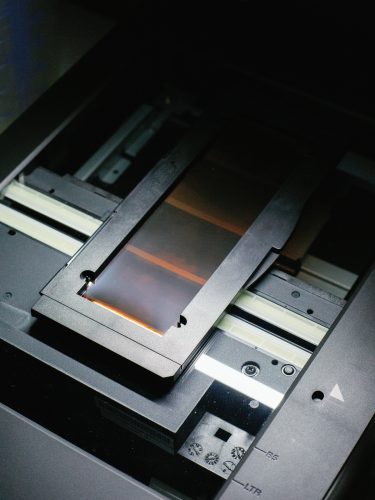
Nevertheless, it serves contemporary needs: sharing images, preparing publications, producing digital prints from negatives, restoring damaged negatives or prints, and archiving photographic collections.
A way of giving photographs a wider circulation without compromising their analogue origins.
I digitise a wide range of materials, including black-and-white and colour negatives, slides, glass plates, silver gelatin prints, and historical photographic collections.